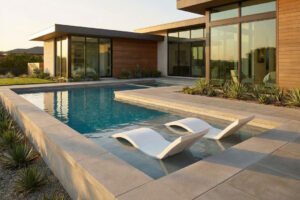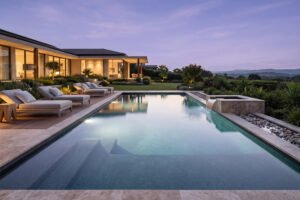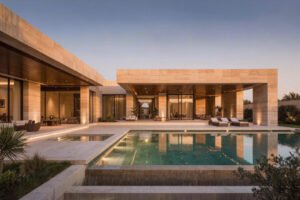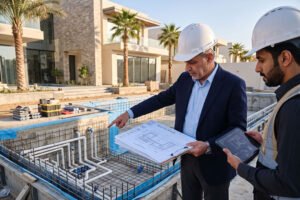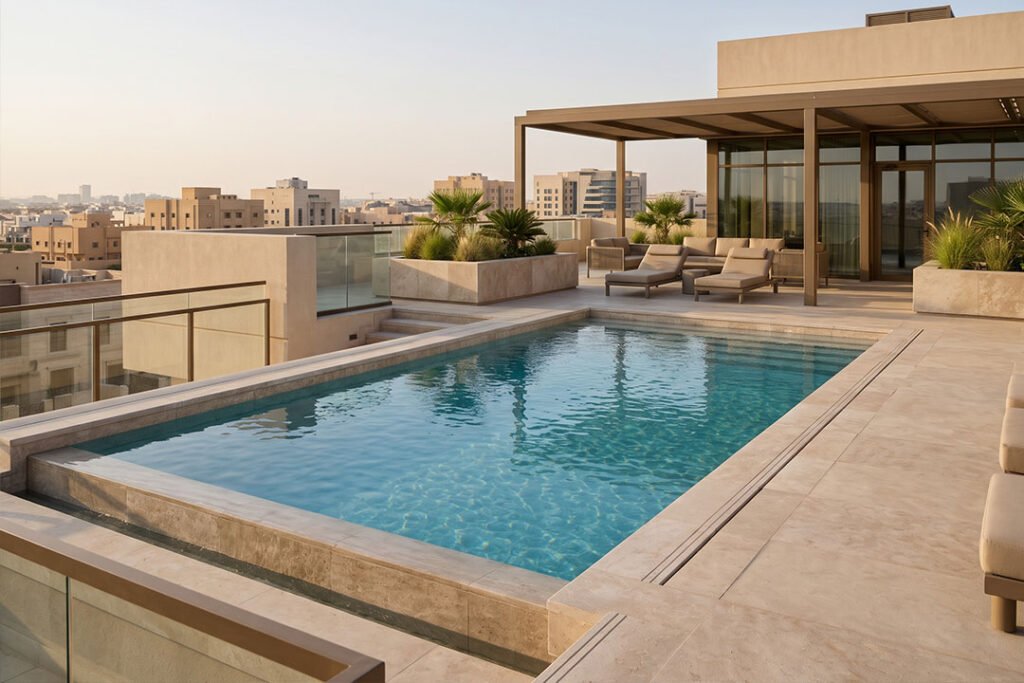
A swimming pool on the rooftop of a luxury building may create an extraordinary scene…
Crystal-clear water, an open view, and a space that offers a different sense of privacy and relaxation.
But behind this scene lies a question far more important than the pool’s appearance or the beauty of its surroundings:
Was the building designed to support all that water?
Building a rooftop swimming pool is not simply a matter of moving a ground-level pool design to a higher elevation.
It involves a different set of structural, engineering, and operational requirements, beginning with the building’s load-bearing capacity and extending to waterproofing, water systems, maintenance, and safe use.
Water May Look Weightless… But It Is Heavy in Structural Calculations
Water may appear to be a simple, peaceful element within an architectural setting.
But its weight changes the way the entire project must be approached.
One cubic meter of water weighs approximately one metric ton, even before accounting for the weight of the pool structure, finishes, equipment, users, and other loads.
For this reason, determining the depth and dimensions of a rooftop pool is not merely an aesthetic decision.
It must be based on a specialized structural assessment that examines the slabs, beams, columns, and foundations, as well as how loads are transferred through the building.
A rooftop may offer enough space to accommodate a swimming pool from an architectural perspective…
Yet it may not be structurally capable of supporting its loads.
Available space does not necessarily mean that construction is feasible.
Design Begins With the Building… Not the Pool’s Edge
In ground-level swimming pools, design is closely connected to soil conditions, site characteristics, and construction requirements.
In elevated swimming pools, however, the building itself becomes an essential part of the project’s load-bearing system.
This is why rooftop pool design requires early coordination between structural engineers, architects, and specialists in swimming pool systems, waterproofing, and mechanical, electrical, and plumbing works.
The pool’s location, depth, support system, and piping routes are all decisions that influence the building’s design and load distribution.
In existing buildings, structural feasibility assessments become even more important before approving a concept or beginning modifications.
For new developments, incorporating the swimming pool into the plans from the earliest stages allows suitable solutions to be studied in a more integrated manner.
The right decision does not begin by asking what the swimming pool should look like…
It begins by understanding what the building can safely and realistically accommodate.
Waterproofing Protects More Than the Swimming Pool
In a ground-level swimming pool, waterproofing failure may allow water to leak into the surrounding soil or adjacent areas.
But when the pool is positioned above an occupied floor or an interior space, the effects of leakage may extend to structural elements, finishes, and building systems below.
This makes waterproofing and water drainage systems among the most important aspects of the design.
The assessment is not limited to waterproofing the pool basin itself. It also includes structural joints, pipe penetrations, connections between the pool and surrounding rooftop surfaces, and appropriate methods for containing and draining leaked water according to the project’s characteristics.
Some designs may require additional protective layers or secondary containment systems, along with suitable provisions for inspection and leak detection.
The objective is not only to prevent water from escaping the pool… but also to protect the building if an unexpected failure occurs.
Where Do the Equipment Rooms and Pipework Go?
Available rooftop space may be limited, while the swimming pool system still requires pumps, filters, water treatment equipment, piping, and control systems.
This is where planning equipment locations and pipe routes from the beginning becomes essential.
The location of the equipment room must account for operating requirements, maintenance access, structural loads, appropriate equipment ventilation, and noise and vibration control where necessary.
Water supply and drainage routes must also be considered, along with how piping can be installed without compromising waterproofing integrity or structural elements.
In some projects, solutions may allow equipment to be located on a different level from the swimming pool, depending on the system’s requirements and hydraulic design.
However, these decisions should not be made simply to keep equipment out of sight.
They should achieve a balance between the beauty of the space and the ability to operate and maintain it efficiently.
An Open View Comes With Different Conditions
One of the most distinctive features of a rooftop swimming pool is the sense of openness and expansive views it provides.
However, depending on the building’s height and surroundings, this location may be more exposed to wind and sunlight than a pool enclosed by walls and a ground-level garden.
These conditions can influence user comfort, water evaporation rates, water temperature, and the selection of shading structures, barriers, and outdoor finishes.
Safety requirements around exposed edges, user circulation, and slip-resistant surfaces must also be considered while preserving the views that inspired the project in the first place.
The objective is not to enclose the space completely in order to protect it…
It is to design it in a way that balances openness, comfort, and safety.
How Will Equipment Reach the Rooftop… and How Will It Be Maintained Later?
A rooftop swimming pool may look spectacular once the project is complete, but accessing its location during construction and maintenance can be more complicated than with ground-level pools.
Lifting materials and equipment, moving work crews, and carrying out future replacements all require planning appropriate to the building’s characteristics.
Providing enough space to install equipment is not sufficient.
It is also important to consider how the equipment can be accessed, inspected, removed, or replaced when necessary without damaging the surrounding elements.
These considerations may influence equipment layout, access opening dimensions, and service routes.
Good design does not simply make a project possible to construct…
It also makes it practical to operate and maintain.
Is Every Rooftop Suitable for a Swimming Pool?
Not necessarily.
The feasibility of building a swimming pool depends on the results of a structural assessment, waterproofing and drainage requirements, equipment and service routes, and applicable safety and permitting regulations.
The assessment may reveal that the project requires carefully planned structural modifications, a different pool location or dimensions, or an alternative solution better suited to the building’s capabilities.
In some cases, constructing a rooftop swimming pool may not be an appropriate option at all.
This does not mean abandoning good design.
It means placing sound engineering decisions ahead of the desire to recreate an attractive image.
At Safwaa Pools, we believe successful aquatic projects begin with understanding the possibilities and limitations of the site, then developing a solution that balances the architectural vision with technical requirements.
Because the best design is not always the most visually striking…
It is the one best suited to the place where it will be built.
Conclusion
A rooftop swimming pool can offer a distinctive architectural experience, bringing together water, panoramic views, and privacy in an extraordinary setting.
But this experience depends on decisions that remain unseen in photographs.
From the building’s ability to support the required loads to waterproofing protection, system coordination, and maintenance accessibility, engineering details work together to make the concept technically feasible and thoughtfully planned.
Because a rooftop swimming pool needs more than an exceptional view… it needs engineering worthy of that view.
Safwaa Pools
We Design Experiences… Not Just Pools.