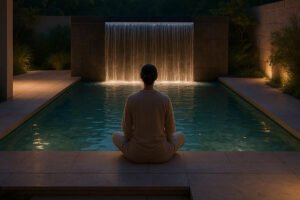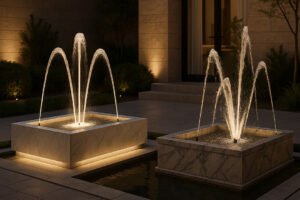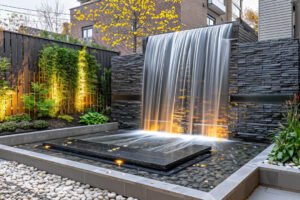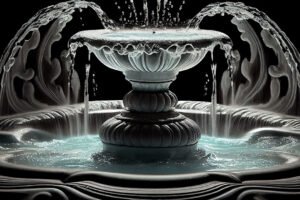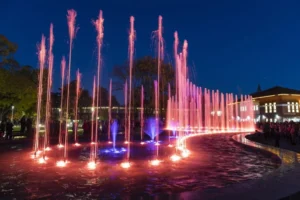
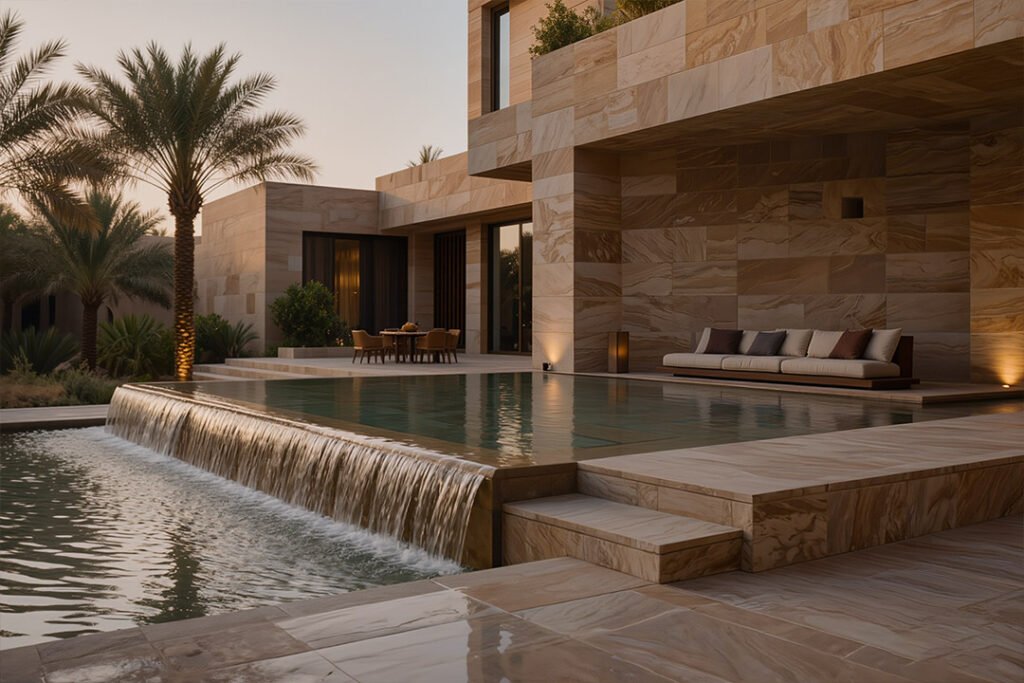
The sound of water in a space’s design is not merely a natural consequence of its flow; it can become an integral part of the fountain or waterfall experience.
You might look at a fountain or a waterfall and see their movement.
But there is another part of the experience that the eye does not see…
It can only hear it.
The sound of water is not simply a natural result of its flow. It can become an intentional element of the design, just like lighting, materials, and the surrounding spaces.
Calm water does not create the same feeling as a flowing stream or water falling from a height.
That is why, when designing a water feature, it is not enough to ask:
How will it look?
It is also important to ask:
How will it sound?
American Society of Landscape Architects (ASLA)
Fountain Design and the Sound of Water: Not Every Sound Suits Every Location
A fountain at the entrance of a home creates a different presence from a waterfall beside an outdoor seating area.
In a space designed for relaxation, a gentle flow may be more in harmony with the surroundings.
Another project, however, may benefit from more noticeable water movement that gives the feature a stronger presence.
It is not simply about making the water louder or quieter…
It is about choosing the type of movement, the height of the fall, the flow rate, and the location of the water feature according to the space around it.
Distance Changes the Experience
The same waterfall can feel completely different when its position changes.
When it is very close to a seating area, its sound becomes a direct part of the experience.
When it is farther away, it becomes a quieter presence in the background.
This is where the relationship between the water feature and the surrounding spaces becomes important.
Sound does not travel through an empty space…
It travels through a place with walls, pathways, plants, open areas, and other sources of sound.
That is why the location of the water is also part of designing its sound.
The Movement of Water Creates Character
Water flowing gently creates a different feeling from water falling or moving more rapidly.
A fountain with a steady rhythm feels different from one designed around changing water movement.
Even the way water meets the surface below can influence the character of the resulting sound.
That is why the same details that shape the visual water display can also shape its acoustic character.
Privacy Is Not Only Visual
When we talk about privacy in outdoor spaces, we often think about walls, plants, and pool orientation.
But sound can also influence how private a space feels.
A thoughtfully positioned water feature can help make surrounding sounds less noticeable within the experience, particularly in outdoor spaces.
But this is not achieved simply by adding a fountain.
It depends on its location, the nature of the water flow, its distance from the seating area, and the sounds surrounding the space.
Water You Feel Before You See
One of the most beautiful things a well-designed water feature can add is a presence that begins before you see it.
You may hear gentle water movement from behind a wall.
Or hear a fountain while walking through a pathway.
Or catch the sound of a waterfall before seeing it from another part of the garden.
At that moment, water becomes part of the experience of the entire space, rather than simply an element placed in one location.
Conclusion
Water design is not only about what we see.
Water moves, reflects, and changes with the light…
And it can be heard as well.
That is why successful water-feature design does not simply seek the most beautiful visual scene, but the experience that feels most harmonious with the space.
Because some details are not seen by the eye…
Yet they can completely change how a place feels.Safwaa Pools
We Design Experiences… Not Just Pools.