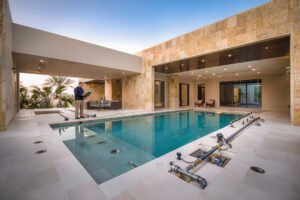
You may choose yourswimming pool’s interior finish based on a photograph you admire…
And imagine the water will look exactly the same once the project is complete.
But after filling the pool, you may discover that the color is different from what you expected.
Perhaps it appears bluer, takes on a turquoise hue, or changes between morning and evening.
This does not necessarily mean the material or finish is different…
Because the color of the water we see is not determined by the finish alone.
Color Begins at the Bottom of the Pool… But It Doesn’t End There
Interior finishing materials play an essential role in determining the visual appearance of pool water.
Light-colored finishes can give the pool a bright appearance with clear, luminous water tones, while darker finishes may create a sense of greater color depth and intensity.
However, choosing tiles or mosaic in a particular shade does not necessarily mean the water will appear in that exact color.
What we see on the pool’s surface is the result of how light interacts with the water, the interior finish, and the surrounding environment.
This is why the same finishing material can produce a different visual result from one project to another.
Depth Changes What the Eye Sees
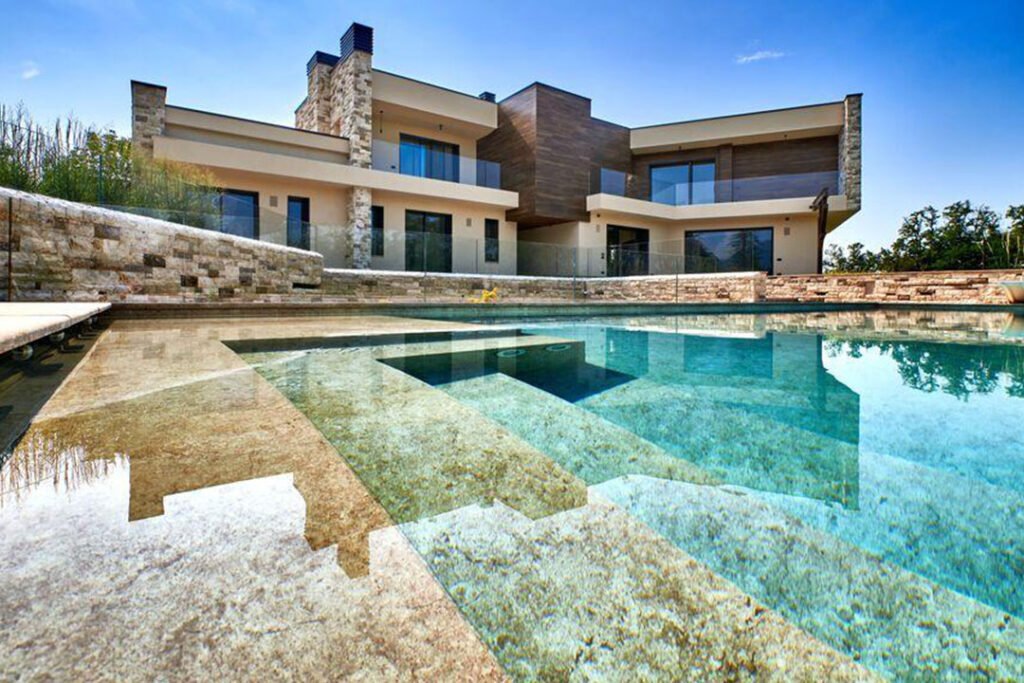
You may notice that the water appears lighter near the steps or shallow areas, while its color becomes deeper toward the deeper sections of the pool.
Even though the same finish is used throughout.
The reason is that light interacts with water differently depending on its depth, affecting the amount of light that reaches our eyes and the colors we perceive.
As depth increases, shades of blue or turquoise may appear more intense, while the interior finish becomes more visible in shallow water.
A single swimming pool can therefore display multiple shades of color… without any variation in its finishing materials.
Sunlight Paints a Different Color Throughout the Day
The color of the water at midday may not be the same as the color you see just before sunset.
The angle and intensity of sunlight, shaded areas, and reflections of the sky on the water’s surface all influence the pool’s final appearance.
Under strong natural light, the water may appear brighter and clearer.
Meanwhile, shadows and softer lighting can make its color seem deeper or less vibrant.
Even a carefully designed swimming pool does not maintain one constant visual color throughout the day.
These changes are not necessarily a flaw…
They are part of the natural visual character of water.
The Surroundings Become Part of the Reflection
The color of pool water cannot be separated from its surrounding environment.
Glass façades, natural stone, trees, green spaces, and even the color of the sky can influence the reflections visible on the water’s surface.
Dense greenery may create green reflections across the water, while light-colored architectural materials can produce an entirely different visual atmosphere.
This is why a swimming pool should not be viewed as a visual element independent of the villa or garden design.
It is part of an architectural composition in which water interacts with everything around it.
Why Isn’t a Photograph Enough to Choose the Color?
A reference photograph may be beautiful and convincing…
But it does not tell the whole story.
The pool shown in the image may differ from your project in depth, water surface area, interior finish, lighting direction, and surrounding environment.
Photography settings and color editing can also affect the shades displayed on the screen.
For this reason, reference images are best used to understand the desired aesthetic direction, rather than as a guarantee of achieving an identical water color.
Reviewing finish samples and photographs of completed projects using similar materials, while considering the conditions of your own site, can help establish more realistic expectations of the final result.
When Should a Change in Water Color Raise Concern?
Not every difference in water color is caused by lighting or depth.
If the water develops an unusual color, becomes cloudy, or stains and deposits appear on the interior finishes, other factors may be involved, including water quality, chemical balance, or the condition of the pool surfaces.
In such cases, color should not be treated as a purely aesthetic matter.
Instead, the water, equipment, and finishes should be inspected to identify the cause and determine the appropriate solution.
Maintaining the pool’s beautiful appearance is also closely connected to proper operation and maintenance.
Good Design Considers Color Before the Water Appears
When designing a luxury swimming pool, the decision goes beyond selecting an attractive color from a collection of samples.
It involves understanding the relationship between finishes, depth, lighting, and surrounding materials, and how these elements will collectively influence the final appearance.
At Safwaa Pools, we believe visual details deserve the same level of attention as engineering and functional considerations.
Because successful design is not defined by the beauty of each individual element…
But by the harmony those elements create when brought together.
Conclusion
The color of pool water is not simply a shade selected from a catalog and expected to remain unchanged under every condition.
It is a visual result shaped by light, depth, materials, and reflections, changing with the place and time of day.
Understanding this relationship helps us make more informed design decisions and establish expectations that are closer to reality.
Because the beauty of water is not created by a single shade… but by the details that bring it to life.
Safwaa Pools
We Design Experiences… Not Just Pools.