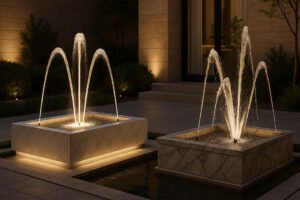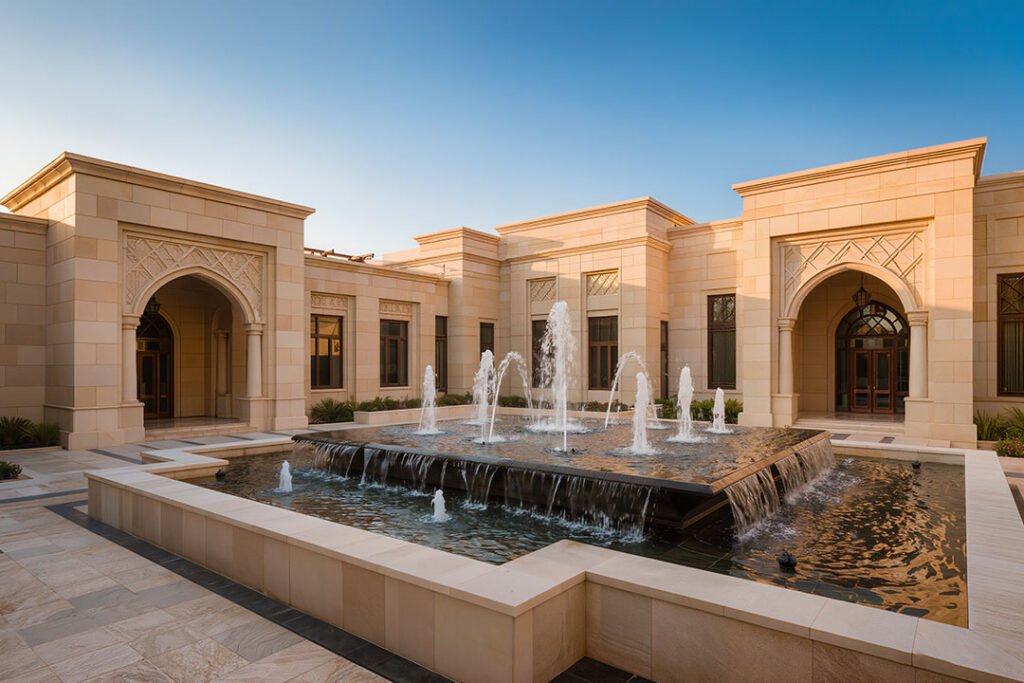
A fountain may look perfect in a moment of calm…
Water flows steadily, jets rise in harmony, and droplets return to the basin exactly as planned.
But what happens when the wind changes?
Water spray may drift off course, reach surrounding walkways and seating areas, or disrupt the visual balance that seemed perfect just moments before.
Because water movement is not influenced by the fountain’s design alone…
It is also shaped by the environment in which it operates.
When Wind Becomes Part of the Design Equation
In outdoor fountains, water does not move independently of the surrounding air.
As water rises and its droplets disperse through the air, the spray becomes increasingly affected by wind, depending on nozzle characteristics, droplet size, and operating conditions.
A fountain may look noticeably different on a calm day compared to one with stronger winds.
That is why site assessment involves more than choosing the most visually appealing location.
It also requires understanding wind exposure, prevailing wind directions, and the fountain’s relationship with nearby walkways, seating areas, and architectural elements.
Because a successful water display should work in harmony with its surroundings… rather than depend on permanently calm conditions.
Water Height Is Not the Only Measure of Beauty
Tall water jets can create a stronger visual presence, particularly in spacious plazas and large architectural developments.
However, height is not the only factor that determines the quality of a water display.
Nozzle type, operating pressure, water flow characteristics, and droplet formation all influence the stability of the display and its susceptibility to wind drift.
In some locations, a more cohesive water stream or a lower jet height may be more appropriate than relying on tall, fine spray that is easily affected by moving air.
This does not mean that tall fountains are unsuitable for outdoor spaces.
Rather, water height should be selected according to basin dimensions, site characteristics, the desired visual effect, and the conditions in which the fountain will operate.
Beauty is not achieved through water height alone…
It also depends on the design’s ability to maintain visual balance.
Where Does the Water Go When It Leaves the Basin?
Not all the water discharged from fountain nozzles necessarily returns to the collection basin.
Wind may carry some of the spray into surrounding areas, while the movement of the water itself can cause droplets to splash beyond the boundaries designed to contain them.
Over time, this may contribute to increased water loss, wet surrounding surfaces, and deposits on certain materials, depending on water quality and the finishes used.
This is where the importance of designing a collection basin that corresponds to the nozzle patterns, jet heights, and flow rates becomes clear.
Basin dimensions, clearances around the nozzles, and the way water returns to the circulation system all influence operating efficiency.
A fountain’s edge may appear to be a simple architectural detail…
But behind it are calculations that determine where the water’s movement ends and how it returns to its intended path.
The Relationship Between a Fountain and Its Surroundings
A fountain may be located near a building entrance, an outdoor seating area, a main walkway, or a space designed to welcome guests.
In these situations, it is not enough for the water display to look beautiful from a particular viewing angle.
It must also suit the way the surrounding space is used.
Repeated water spray near seating areas may affect user comfort, while spray reaching walkways can leave certain surfaces undesirably wet.
The potential effects of drifting water on nearby architectural materials, landscaping, and equipment should also be considered.
For this reason, fountain placement and water movement should be designed in coordination with the other elements of the project.
Because a successful fountain does more than create a beautiful scene… it respects the space that surrounds it.
Can a Fountain Adapt to Changing Winds?
In some projects, control systems can be used to adjust fountain operation as weather conditions change.
Depending on the system design, these controls may allow jet heights to be reduced or operating patterns to be modified. Wind sensors can also be used to trigger specific actions when predefined wind thresholds are reached.
Under certain conditions, it may be necessary to temporarily deactivate selected nozzles or suspend the water display to reduce spray drift.
However, these solutions should not be implemented without careful consideration.
They require an understanding of the fountain type, site conditions, operational requirements, and the intended response of the control system.
The presence of a wind sensor does not replace proper design, monitoring, or maintenance.
The objective is not to add technology simply because it is available…
But to use it when it contributes to a more stable and efficient experience.
Even Small Details Affect Water Consumption
In fountains that rely on water recirculation, a large proportion of the water is reused within the system.
Nevertheless, water losses may continue through evaporation, drifting spray, and routine operation and maintenance.
Reducing these losses begins with design decisions that may appear simple.
These include selecting suitable nozzles, carefully determining collection basin dimensions, limiting spray drift into unintended areas, and monitoring water levels and automatic make-up water systems.
Regular monitoring also helps identify unusual changes and distinguish expected water loss from issues that require investigation.
Fountain efficiency is not determined by the strength of the water flow alone…
It also depends on how that water is managed throughout operation.
Design That Looks Beyond Opening Day
The first moment a fountain begins operating can be impressive.
But a project’s success is not measured by that moment alone.
A water display that integrates with the architecture, accounts for wind movement, minimizes unnecessary water loss, and provides appropriate maintenance access to equipment is better prepared for real operating conditions.
At Safwaa Pools, we believe designing fountains and water features requires an understanding of the relationship between visual composition, engineering systems, and the surrounding environment.
Because the details visitors may not notice at first glance…
Can be the very details that make a difference to the quality of the experience over time.
Conclusion
A fountain is not simply a collection of nozzles operating according to a fixed pattern, unaffected by the natural environment around it.
It is an aquatic system that interacts with the air and its surroundings, requiring a balance between the beauty of water movement and operational efficiency.
When environmental conditions become part of the design process, the objective is no longer merely to create a beautiful water display under perfect conditions.
It is to design a fountain capable of delivering a thoughtfully planned experience under varying conditions.
Because the beauty of a fountain is not measured only by how high the water rises… but by how carefully its journey is controlled, from the moment it begins until it returns.
Safwaa Pools
We Design Experiences… Not Just Pools.