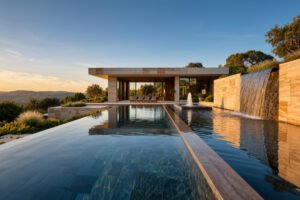
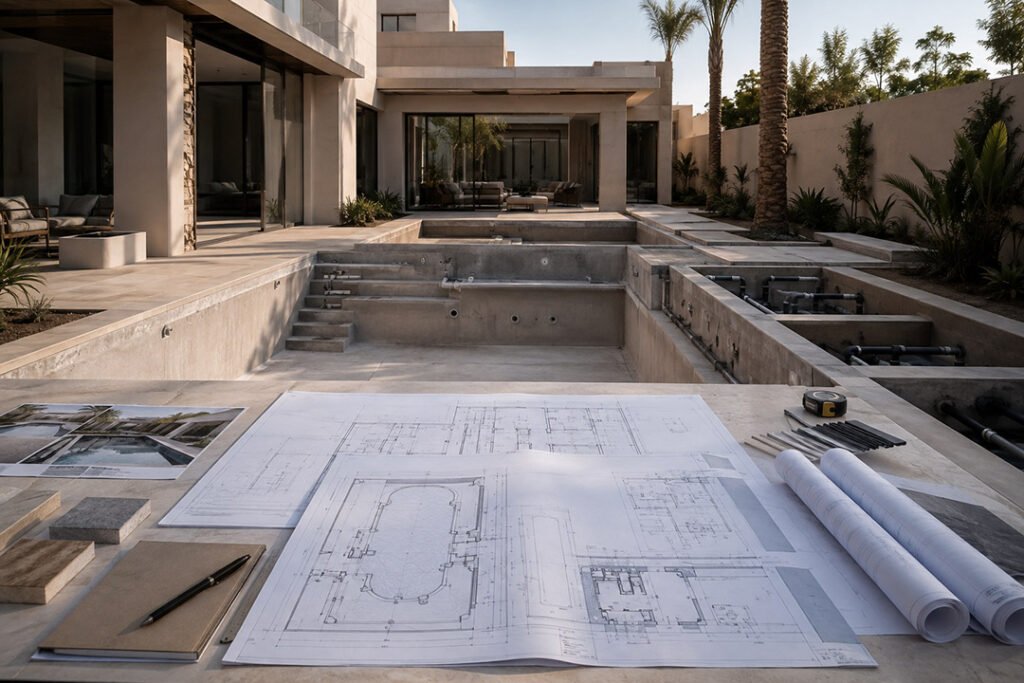
The right decisions are made before the first stone is laid.
In any project, the moment construction begins may seem like the most important moment.
Work starts on site, construction teams begin their work, equipment arrives, and the project gradually begins to take shape.
But the reality is that a significant part of the project’s success has already been determined before all of this.
Before excavation begins.
Before equipment is selected.
And before the first stone is laid.
Because what happens on site is often the result of decisions that were made much earlier.
The Beginning Is Not Always at the Project Site
When looking at a swimming pool, fountain, waterfall, or steam room project, it is natural to focus on the final result.
The design.
The materials.
The architectural details.
And how the project will look once completed.
But behind that final image is a long series of decisions that may not be immediately visible to the client.
How will the project be used?
Who will use it?
What are the characteristics of the site?
Which systems are suitable for it?
How will future maintenance be carried out?
Where should the equipment be located?
How will the systems interact with the architectural and structural elements?
And what could happen if one of these elements changes during construction?
These questions are not secondary details.
They are part of the design itself.
The Right Decision at the Beginning Saves a Lot Later
One of the most common mistakes in projects is treating early decisions as matters that can easily be changed at any time.
But every decision becomes more difficult and costly the later it is made.
Choosing the equipment room location after structural work has been completed is not the same as determining it from the beginning.
Modifying plumbing routes after finishes have been installed is not the same as coordinating them before construction.
Adding a control system or new equipment after the project is completed is not the same as preparing the required infrastructure during the design stage.
That is why good planning is not only about knowing what will be built…
It is also about knowing:
When should each decision be made?
A Project Is Not a Collection of Separate Tasks
In specialized projects, individual elements do not work independently.
The swimming pool is connected to the hydraulic systems.
The systems are connected to the equipment room.
The equipment room is connected to the site’s layout and service routes.
Lighting is connected to the architectural design.
And the finishes must be compatible with the intended use and environmental conditions.
Ultimately, all of these elements must work together as one integrated system.
That is why project success does not depend only on the quality of each individual element.
It also depends on how well those elements work together.
The equipment may be excellent, the design may be beautiful, and the execution may be precise…
But if these elements were not coordinated from the beginning, problems may appear that could have easily been avoided during the planning stage.
What You Don’t See Today May Affect the Project for Years
There are many parts of a water project that do not appear in the final image.
Water lines.
Waterproofing.
Pumps.
Filtration systems.
Control systems.
Electrical systems.
Equipment rooms.
And access routes for maintenance and servicing.
Users may never notice these elements while enjoying the pool or fountain.
And that is actually a good sign.
Because the best systems perform efficiently without imposing their presence on the experience.
But achieving that result requires thinking about them before construction, not after it. .
What Happens When a Decision Is Made Too Late?
When an important decision is made late, its impact is rarely limited to one element.
It may require a design modification.
Or rework.
Or changes to service routes.
Or more expensive equipment.
Or make future maintenance more difficult.
Sometimes, the final available solution may even be less efficient than the solution that could have been implemented if the issue had been considered from the beginning.
And this is where the difference becomes clear between:
Building a project… and
managing a project from an integrated engineering perspective.
Good Planning Does Not Mean Planning for Perfection
No project is completely free from changes.
Unexpected conditions may arise during construction.
But the purpose of planning is not to prevent every possible change.
It is to make the project better prepared to deal with them.
When systems are properly studied, options are clearly defined, and coordination between disciplines begins early, changes become easier to manage and are less likely to develop into larger problems.
Good planning does not mean that everything will happen exactly as originally drawn.
It means that the project has a strong foundation that allows it to respond to reality.
Before You Ask: How Much Will the Project Cost?
There is another question worth asking first:
What does the project actually need?
Because cost is not simply the price of equipment, materials, or construction work.
The true cost is also related to the system’s lifespan, operating efficiency, ease of maintenance, accessibility of equipment, and the likelihood of requiring modifications in the future.
A particular option may appear less expensive initially…
But if it results in higher operating costs, more complicated maintenance, or repeated modifications, it may not be the most economical choice in the long run.
That is why a good engineering decision does not always look for the lowest cost.
It looks for the best value for the investment.
This Is Where the Real Project Begins
Before construction starts, there is another stage that is just as important.
The stage of thinking.
Studying the site.
Understanding how the project will be used.
Defining the requirements.
Selecting the right solutions.
Coordinating the different systems.
And anticipating the project’s needs not only when it opens…
But years after it begins operating.
Because a good project is not measured only by how it looks on opening day.
It is measured by its ability to continue delivering the performance, efficiency, and experience it was designed to provide.
Conclusion
At Safwaa Pools…
We do not see the planning stage as simply a step that comes before construction.
We see it as an essential part of creating the project itself.
Every detail considered early, every system carefully selected, and every decision coordinated with the rest of the project…
Contributes to a result that is more efficient, more reliable, and better prepared to perform over time.
Because a successful project does not begin when the construction team arrives on site…
It begins when the right decisions are made long before that.
Safwaa Pools
We Design Experiences… Not Just Pools.