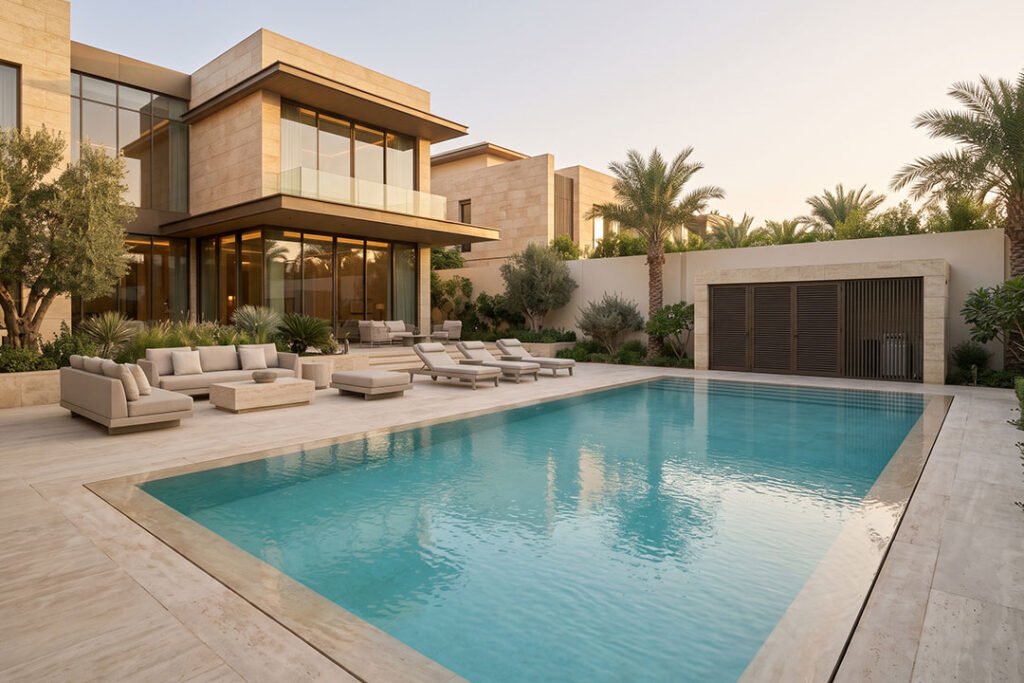
You may be sitting beside a luxurious swimming pool on a peaceful evening…
Crystal-clear water, elegant lighting, and a space designed to offer moments of relaxation.
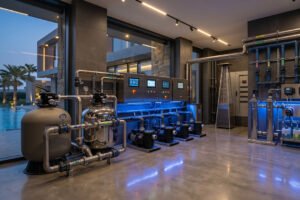
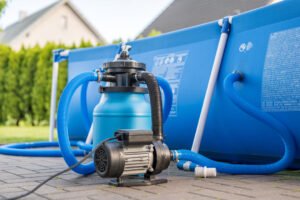
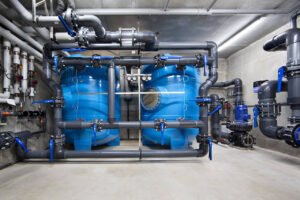
Yet behind this scene, pumps, filtration systems, and water treatment equipment are working to maintain water quality and keep the pool operating.
This raises a question we rarely consider when choosing a design:
Can you enjoy the tranquility of a space… while its systems continue operating in the background?
The quality of a swimming pool experience is not defined only by what we see, but also by what we hear.
Sometimes, some of the most important design decisions are those that help keep equipment noise away from the peaceful moments the space was created to provide.
Not Every Sound Comes From the Water
The gentle sound of a waterfall or flowing water may be an intentional part of the experience.
But sounds produced by pumps, motors, and piping are different in nature and impact.
These sounds are not typically introduced as aesthetic features. They are generated by the systems responsible for operating the pool.
Their intensity may vary depending on the type of equipment, operating conditions, installation methods, and proximity to occupied spaces.
For this reason, creating a peaceful pool environment does not mean shutting down its systems or compromising their efficiency…
It means designing and installing them in ways that minimize unwanted noise.
Because a peaceful experience is not achieved simply by hiding equipment from view… but by considering its impact on the surrounding space.
Equipment Room Location Is About More Than Available Space
Choosing a location for the equipment room may seem like a matter of finding sufficient space within the project.
However, its location also affects how the pool interacts with the surrounding environment.
Positioning pumps near an outdoor seating area, bedroom, or relaxation space may make operational noise more noticeable than users expect.
On the other hand, moving equipment farther away without proper planning may increase piping lengths and affect hydraulic requirements and system efficiency.
This highlights the importance of balancing several considerations: equipment room location, proximity to the pool, system characteristics, piping routes, and maintenance accessibility.
The goal is not necessarily to choose the most distant location…
But to select the one that achieves the right balance between engineering performance and user comfort.
Vibrations Can Travel Even When Equipment Is Far Away
Not every sound reaching the surrounding spaces travels through the air alone.
Some vibrations may be transmitted from pumps into mounting bases, pipes, or connected structural elements.
As these vibrations travel, they may produce audible noise or noticeable movement in areas where the equipment itself is not located.
For this reason, some projects require careful consideration of suitable mounting and vibration isolation methods, along with how piping is supported and connected to equipment and structural elements.
Mounting systems, vibration isolators, and flexible connections may help reduce unwanted vibration transmission when appropriately selected for the equipment and system design.
However, these solutions must be selected and installed in accordance with manufacturer recommendations and the project’s technical requirements.
Because a quiet environment does not depend on distance alone… but also on how movement and sound are transmitted.
Sometimes, the Problem Is Not the Pump’s Normal Operating Noise
A pump may produce unusual sounds due to operating conditions that are not necessarily related to the motor’s normal noise level.
Air entering suction lines, restrictions in water flow, or unsuitable hydraulic conditions may disturb water movement and produce additional noise.
One example is cavitation, which can occur under certain conditions inside a pump, affecting its performance and generating abnormal noise or vibrations.
For this reason, addressing noise does not always begin with adding sound insulation or enclosing the equipment room.
It may first require inspecting water flow paths, pump condition, and overall system operation.
Some sounds are more than a disturbance…
They may be an indication of a technical issue that requires investigation.
Does a More Powerful Pump Mean a Better Experience?
When selecting swimming pool equipment, choosing a higher-capacity pump may seem like a way to achieve better performance.
However, pump power alone does not determine operating quality.
What matters is selecting equipment that matches the required flow rate, pressure losses throughout the piping system, filtration and treatment requirements, and intended use.
Pump operating speed and load conditions can also influence the noise it produces.
In systems that support them, variable-speed pumps may help adjust operation according to actual demand instead of relying on a fixed speed under all conditions.
However, this does not mean that every variable-speed pump will operate more quietly in every situation.
The right choice depends on the design of the entire system, not on a single equipment feature.
Sound Insulation Does Not Mean Completely Sealing the Equipment Room
Surrounding equipment with thick walls or tightly enclosing the room may seem like a straightforward solution to reducing noise.
However, equipment rooms also require appropriate operating conditions.
Motors and other equipment may need ventilation to dissipate heat, sufficient access for maintenance, and specific provisions for moisture control, drainage, and electrical safety.
Overlooking these requirements while attempting to reduce noise may create new operational problems.
For this reason, acoustic treatment must be integrated with the room’s mechanical, electrical, and structural design.
In projects requiring particular levels of noise control, a specialized acoustic assessment may be necessary to identify solutions compatible with the equipment and ventilation requirements.
A good solution should not improve one aspect of the experience at the expense of system safety or efficiency.
Quiet Operation Is Planned Before the First Pump Starts
Noise problems may only become apparent after the project is completed and the pool enters regular use.
At that stage, relocating equipment or modifying piping routes can be more complicated than addressing these considerations during design.
This is why equipment room location, pump characteristics, nearby seating and living areas, vibration isolation, and ventilation requirements should be considered early in the project.
Equipment performance should also be evaluated during testing and initial commissioning, with attention given to unusual sounds before confirming that the system is ready for operation.
This does not mean a swimming pool must operate in complete silence.
Every system has its normal operating characteristics.
The goal is to maintain noise at levels appropriate for the project’s nature and intended use, without allowing it to dominate the experience of the space.
When Quiet Comfort Becomes Part of Luxury
Users may notice the quality of the pool’s finishes, the beauty of water reflections, or its harmony with the surrounding architecture.
But they may never think about where the pumps are located, how they are mounted, or the routes pipes follow behind the walls.
Nevertheless, these decisions can influence everyday comfort.
At Safwaa Pools, we believe successful design goes beyond creating a beautiful water feature or an efficient operating system.
It is built on the integration of aesthetics, engineering, and practical use, ensuring that technical details support the experience the project was designed to deliver.
Luxury is not always about adding something new…
Sometimes, it is about reducing what might disturb the moment.
Conclusion
A swimming pool is more than a basin of water surrounded by luxurious finishes.
It is a system that operates according to ongoing requirements, with technical details that influence the user’s experience.
From equipment room placement to pump selection, mounting methods, and piping routes, thoughtful engineering decisions can help preserve the tranquility and comfort of the space.
Because a luxury swimming pool is not designed merely to impress the eye… but to offer comfort that is not overshadowed by the sounds of the systems working behind the scenes.
Safwaa Pools
We Design Experiences… Not Just Pools.